Augmented CIO: how is artificial intelligence reinventing a strategic role?
Artificial intelligence is no longer an experimental topic for IT departments. Within just a few quarters, it has become a major transformation lever, reshaping productivity dynamics and disrupting the economic models of software publishers, IT service providers and their clients. The Chief Information Officer now finds themselves at the heart of this transformation: no longer merely the custodian of the information system, but a key player of organisational competitiveness.
When AI reshuffles
the cards
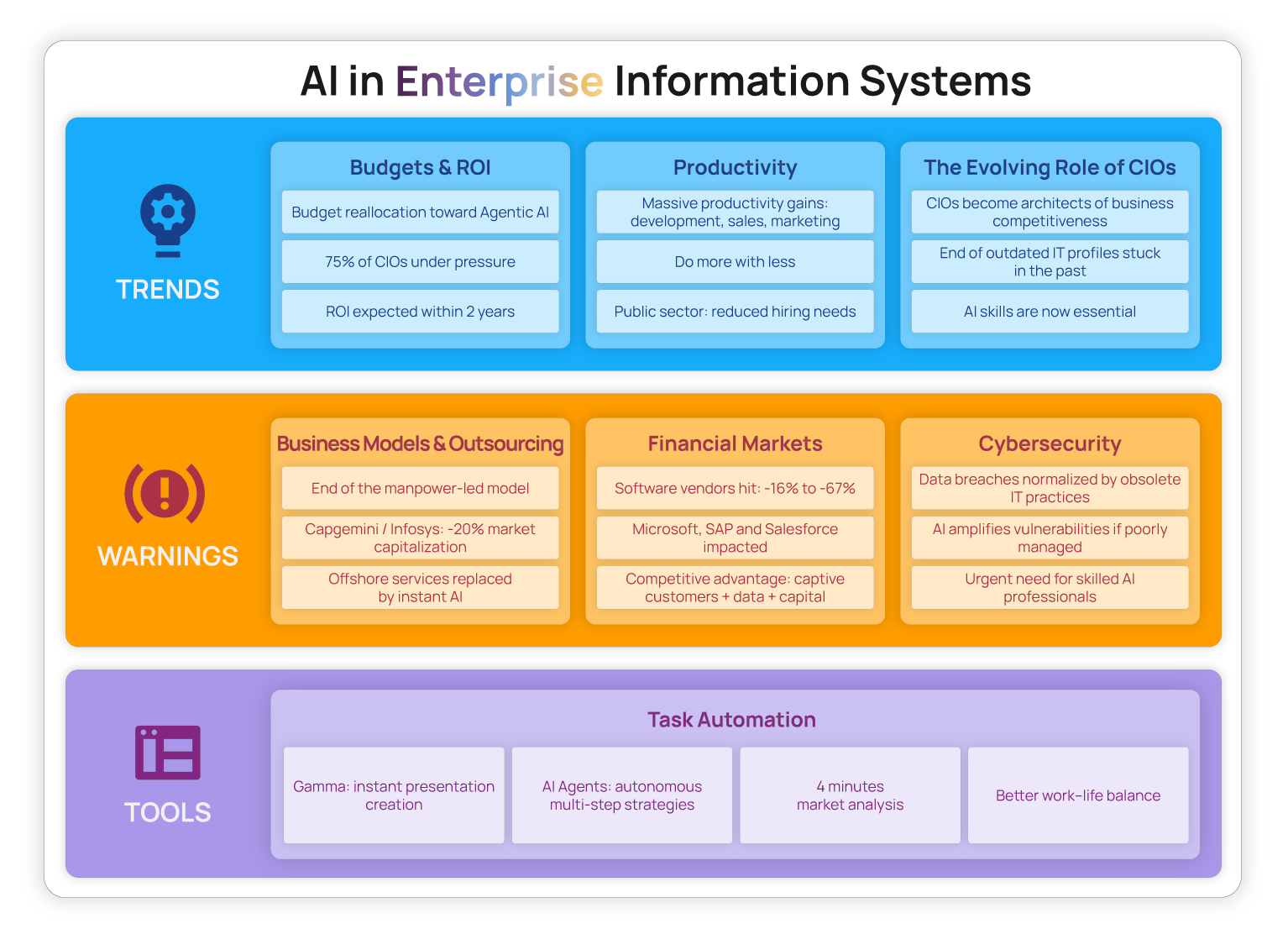
The era of experimentation is over. In 2026, AI is no longer a laboratory topic included in a five- or ten-year roadmap. It is an operational lever permeating the entire value chain of organisations, from software development to commercial steering, including operations and customer support. The figures are unequivocal: according to the Gartner CIO Survey 2026, 91% of organisations are increasing their investments in generative AI, with an average 38% rise in allocated budgets. This massive reallocation is not a passing trend. It is a strategic repositioning that directly impacts mediumterm competitiveness.
Budgets and ROI: the end of the status quo
The pressure on CIOs has never been greater. Executive committees now require tangible return on investment within eighteen months. The time for inconclusive proofs of concept and experiments disconnected from the business model is over. Regarding most of the new budget allocations are now concentrated around agentic AI, i.e. systems capable of autonomously executing complex task chains. Executive committees expect measurable outcomes: productivity gains, reduced time to market, improved Net Promoter Score, and optimised cost structures.
The challenge is significant. As highlighted by Gartner, CIOs have approximately eighteen months before boards of directors begin asking difficult questions regarding profitability. Unlike cloud migrations, where savings are measurable, the benefits of AI often manifest as capability enhancements that are difficult to translate into a simple ROI calculation. The most mature organisations have understood this: 63% already conduct rigorous financial analyses on risk factors and concretely measure customer impact.
The message is clear. AI is no longer an additional cost centre. It is a strategic investment whose performance must be managed with the same level of rigour as an industrial transformation programme.
Productivity: doing more with less, but above all doing better
Observed productivity gains are substantial. In software development, for instance, code assistants such as GitHub Copilot or Claude Code reduce repetitive input tasks by 30% to 50% and significantly accelerate delivery cycles. Sales teams automate proposal generation, competitive analysis and lead scoring. Marketing produces personalised content at a scale that would have been inconceivable three years ago.
This evolution is reshaping development teams and widening the gap between junior and senior profiles: junior roles are losing the learning tasks that traditionally structured skill development, while senior profiles take on architecture, critical review and agent orchestration. CIOs must anticipate this reconfiguration: revisiting career paths, massively upskilling teams on development-support tools, and redefining what it means to be a developer in an organisation where an increasing share of software production is AIassisted or automated.
Software development deserves particular attention, given the profound disruption it brings. Beyond the data entry support, tools such as Claude Code and GitHub Copilot Workspace are now capable of executing end-to-end development tasks autonomously and continuously. At the same time, AI-powered no-code and low-code platforms enable the creation of functional interfaces without writing a single line of code, opening software development to business users.
This evolution is disrupting development teams and widening the gap between junior and senior professionals. Junior developers are seeing many of the learning tasks that traditionally construct their skills development disappear, while senior practitioners increasingly focus on architecture, critical review and the orchestration of AI agents. CIOs must anticipate this shift: redesigning career paths, scaling training on AI-assisted development tools, and redefining what it means to be a developer in an organisation where an ever-growing share of software production is augmented or automated by AI.
However, the real paradigm shift is not about volume. It is about the very nature of work. AI does not replace employees. It shifts them towards higher-value activities: architectural design, critical review, strategic decision-making and the management of complex customer relationships. The traditional model of “doing more with less” is evolving into one of “doing better with augmented intelligence”.
This dynamic is impacting the public sectors where reduced recruitment needs for administrative tasks are enabling resources to be redeployed towards citizen services and service modernisation. But it is also impacting private sectors where support functions and shared service centres are undergoing a similar transformation. Offshore delivery, long a cornerstone of the business model of IT services companies, is gradually being challenged by instant AI capabilities, available around the clock, without time-zone constraints or language barriers.
Financial markets
Financial markets have sent a strong signal. Since late 2025, software and IT services providers have been facing growing pressure from investors questioning their ability to integrate artificial intelligence into their business models and demonstrate the value it creates.
This reaction extends beyond share-price performance. It reflects a now widely held conviction: value no longer lies solely in the ability to develop software or mobilise human resources, but in the ability to industrialise AI and transform it into a sustainable competitive advantage.
The IT services sector is particularly affected. Business models historically built around billing consultant days are being challenged by the emergence of tools capable of automating certain tasks in a matter of minutes. However, AI does not signal the end of these organisations. Rather, it is accelerating their evolution towards higher-value activities: consulting, systems integration, governance, change management and business expertise.
For CIOs, this evolution is an important signal. A provider’s ability to embed AI sustainably within its offerings, evolve its delivery model and invest in skills development is becoming a selection and governance criterion in its own right. More than ever, the choice of technology partners contributes directly to organisational competitiveness.
The CIO of tomorrow: from technical architect to competitiveness strategist
The role of the Chief Information Officer is undergoing its most profound transformation since the democratisation of the internet. For two decades, the CIO was perceived as the guardian of infrastructure, the guarantor of information system availability, and the manager of a cost centre closely ans suspiciously monitored by executive leadership. That era is over. AI is placing the CIO at the heart of business strategy—provided they are willing to reinvent their role.
From cost centre to value-creation engine
The transformation is drastic. The CIO is no longer simply responsible for “keeping the lights on”. The role is evolving into that of an architect of digital competitiveness and a strategic partner to the Executive Committee in defining and executing the organisation’s innovation roadmap. This shift requires a fundamental change in mindset: moving from technical language to business language, translating technological possibilities into value-creation opportunities, and quantifying both benefits and risks in terms that resonate with the finance function.
CIO profiles shaped since the late 1990s, with expertise centred on infrastructure management and traditional project delivery, are structurally ill-equipped for this new reality. AI capabilities are no longer a “nice to have” : they are becoming core competencies of the role. Understanding model architectures, assessing the relevance of use cases, arbitrating between public, private and hybrid models, and managing AI integration into business processes are now essential capabilities of a high-performing CIO.
The challenge extends well beyond individual skills. CIOs must rethink the structure of their organisations: redefining job descriptions, creating new roles (Head of AI, MLOps Engineer, Data Ethics Lead), and reshaping career paths to place greater value on design, governance and change enablement rather than purely technical production. According to KPMG’s 2026 study on IT leadership priorities, AI and automation are by far the leading areas of technology investment, followed by the digital workplace. In this context, CIOs who fail to make AI a strategic priority risk becoming increasingly disconnected from the expectations of their organisations.
Cybersecurity and governance
Cybersecurity represents the second pillar of CIO legitimacy in this new era. The figures speak for themselves. France ranks fourth globally among countries most affected by data breaches. During the third quarter of 2025, more than 15 million accounts were compromised in France, representing a 29% increase compared with the previous quarter. In October 2025, Darktrace observed a 39% increase in abnormal data uploads to generative AI services, with an average volume of 75 megabytes per incident—the equivalent of approximately 4,700 pages of documentation.
AI amplifies vulnerabilities when poorly managed. Hyper-personalised phishing campaigns generated by large language models are among the top concerns of CIOs and CISOs, with 50% ranking them as their primary cybersecurity concern. Vulnerabilities are now being exploited within minutes of disclosure, turning patch management into a continuous race against time.
Paradoxically, AI is also one of the most promising levers for strengthening cyber defence. Real-time analysis of massive volumes of logs, detection of anomalous behaviour and automated vulnerability prioritisation are helping organisations transform their cybersecurity capabilities. However, these benefits can only be realised if AI is embedded within an appropriate governance framework and managed by appropriately skilled teams.
In this context, the demand for professionals skilled in AI-enhanced cybersecurity is becoming critical. Cybersecurity can no longer be treated as a standalone technical issue reserved for specialists. It has become a governance matter that directly affects executive leadership, shareholders and regulatory compliance requirements, including GDPR, NIS2 and DORA.
Co-evolving with AI: putting people at the centre of transformation
There is a temptation to reduce the AI revolution to a matter of tools and budgets. That would be a strategic mistake. The real transformation is about human. It concerns the way teams work, learn, make decisions and reinvent themselves. AI does not replace human intelligence. It extends it, amplifies it and, in some cases, challenges it to evolve. The question is no longer “What can AI do instead of us?”, but rather “How will we evolve alongside it?”
Automating to unlock human intelligence
The technology available to both IT and business teams has evolved dramatically. Tools such as Gamma can generate professional presentations in seconds. AI agents are now capable of autonomously performing complex tasks, including document analysis, competitive benchmarking, information synthesis and deliverable preparation.
These developments are not simply about saving time. They are redefining how work is distributed between humans and machines. Tasks that previously consumed a significant portion of daily activity can now be automated, allowing teams to focus more on analysis, decision-making, design and innovation.
For CIOs, the challenge is therefore not purely technological. It lies in identifying which activities can be delegated to AI and which should remain under human judgement. Value no longer resides in executing repetitive tasks but in applying expertise, critical thinking and business knowledge.
At Coruscant, we observe that the organisations that make the most of AI are not those seeking to automate everything. They are the ones that successfully combine the capabilities of AI systems with the expertise of their people.
The CIO of tomorrow will therefore not be the one who asks teams to produce more. Rather, it will be the one who enables them to devote more time to value-creating activities by leveraging automation to improve the quality of decisions and accelerate execution.
The human factor: soft skills, ai acculturation and managerial courage
The human dimension of transformation is undoubtedly the most decisive and the most neglected. The introduction of AI into organisations generates a wide spectrum of reactions, ranging from enthusiasm to anxiety. Concerns around job substitution, tensions between business and IT teams, and fears of deskilling are real phenomena that leaders must address seriously.
Transferable skills—commonly referred to as “soft skills”—are becoming decisive. Collaboration with business stakeholders, learning, critical thinking, and the ability to assess AI-generated outputs and determine when human intervention remains necessary are qualities that will define tomorrow’s IT professionals far more than mastery of any particular programming language.
Data culture, encompassing data quality, traceability, security and compliance, is becoming a prerequisite for the effective use of AI models. Without reliable, structured and properly governed data, training and deployment initiatives quickly become ineffective—or even counterproductive. Gartner warns that organisations that do not underpin AI use cases with rigorous data practices will see more than 60% of their AI projects fail and ultimately be abandoned.
CIOs bear a unique responsibility here. Their role is not simply to deploy new tools but to create the conditions for successful adoption. This includes AI acculturation programmes, training on right usage, use-case design workshops and the implementation of clear governance frameworks. Organisations that derive sustainable benefits from AI are rarely those deploying the largest number of tools; they are those that invest most effectively in adoption.
Beyond training, genuine managerial courage is required to challenge existing organisational structures, redefine roles and reward capability building rather than technical execution alone. The courage to explain to Executive Committees that AI is not a magic solution but a lever that requires investment, governance and patience; and, above all, the courage to keep people at the centre of transformation rather than succumbing to the temptation of blind automation.
—
The CIO profession has reached a historic inflection point. Artificial intelligence is redefining the relationship between technology, organisation and value creation. No longer simply the guardian of the information system, the CIO is becoming an architect of digital competitiveness, an orchestrator of ecosystems that combine human and artificial intelligence, and a key driver of business transformation.
This evolution goes far beyond the adoption of new tools. It requires organisations to rethink capabilities, collaboration models, governance frameworks and performance metrics. The organisations that succeed will not necessarily be those that invest the most in AI, but those that integrate it most effectively into their strategy and operations.
Ultimately, the success of AI initiatives will not depend solely on the performance of models. It will depend on an organisation’s ability to evolve its practices, capabilities and governance at the same pace as technology. It is at the intersection of technological innovation and human transformation that sustainable value creation will be defined in the years ahead.
References
- Gartner, « Worldwide AI Spending Will Total $2.5 Trillion in 2026 » https://www.gartner.com/en/newsroom/press-releases/2026-1-15-gartner-says-worldwide-ai-spending-will-total-2-point-5-trillion-dollars-in-2026
- GitHub Blog, « Research: quantifying GitHub Copilot’s impact on developer productivity and happiness » https://github.blog/news-insights/research/research-quantifying-github-copilots-impact-on-developer-productivity-and-happiness/
- KPMG, « Priorités des directions IT 2026 » https://kpmg.com/fr/fr/insights/it/priorites-direction-it-2025.html
- Ventury Technology, “Cybersécurité 2025, l’année où les fuites de données sont devenues la norme” https://venturytechnology.fr/cybersecurite-2025-lannee-ou-les-fuites-de-donnees-sont-devenues-la-norme/
- Stanford HAI, « AI Index Report 2024 » https://hai.stanford.edu/ai-index/2024-ai-index-report
- Darktrace, rapport cybersécurité 2025 (via ITforBusiness) https://www.itforbusiness.fr/la-cybersecurite-a-ere-de-ia-en-2026-enfin-des-chiffres-interessants-rapport-darktrace-100081
- Journal du Net, « Cap sur 2026 : des DSI entre protection et transformation » https://www.journaldunet.com/solutions/dsi/1547753-cap-sur-2026-des-dsi-entre-protection-et-transformation/
- CIO Online, “Grand Théma DSI 2026 : les DSI d’ETI aux prises avec l’IA et la relation aux éditeurs” https://www.cio-online.com/actualites/lire-grand-thema-dsi-2026-les-dsi-d-eti-aux-prises-avec-l-ia-et-la-relation-aux-editeurs-16720.html
- Digitalonomics, « Les priorités des DSI pour 2026 » https://digitalonomics.fr/les-priorites-des-dsi-pour-2026/
- Seedext, “Les avancées de l’IA en 2024 et son impact en France” https://seedext.com/en/articles/avancees-ia-2024-impact-france-innovation-google-microsoft
- ZDNET, « Le métier de la DSI transformé par l’IA » https://www.zdnet.fr/blogs/green-si/le-metier-de-la-dsi-transforme-par-lia-393462.htm
- ITforBusiness, “Panorama des cybermenaces 2026 : l’attaque passe en mode industriel” https://www.itforbusiness.fr/panorama-des-cybermenaces-2026-lattaque-passe-en-mode-industriel-99458
- Avant de Cliquer, « Fuite de données : comment protéger votre organisation en 2026 ? » https://avantdecliquer.com/fuite-de-donnees/
- RCB Informatique, « L’Impact de l’Intelligence Artificielle en 2024 » https://www.rcb-informatique.fr/limpact-de-lintelligence-artificielle-sur-le-developpement-logiciel-en-2024/